7.26.2010

Adventures in Italian baking!


Here's a "traditional" Italian ricotta cheese cake that I baked. My additions include the graham crust, and slightly more vanilla. Only slightly sweet, it works as both a coffee and a desert cake. I think next I will make one with huckleberries...

7.16.2010

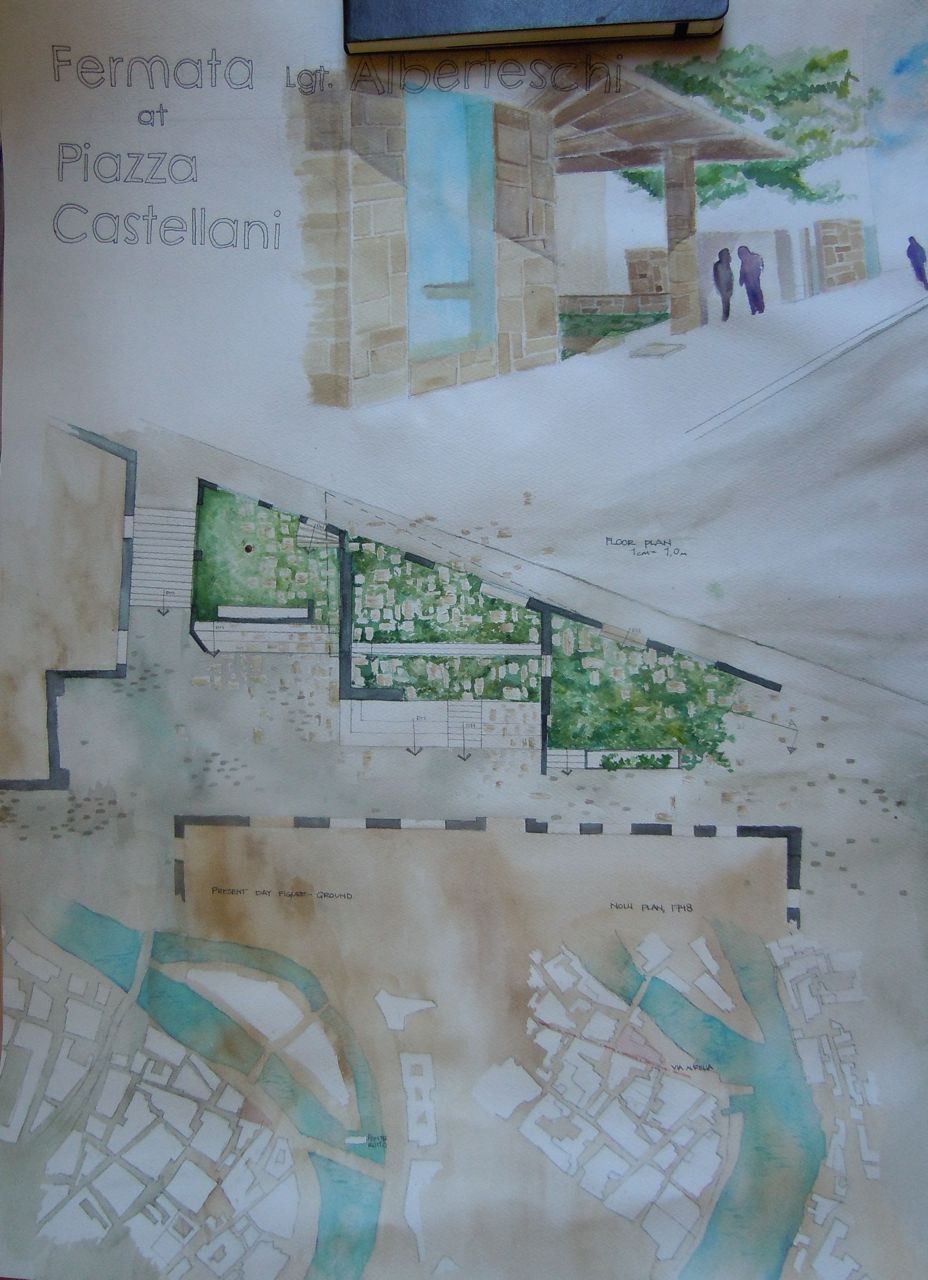
Final Studio Project


Here is my final studio project, done by hand in watercolor. Please excuse the awful pictures, the boards had been rolled and were warped by the water as well. Everyone's projects were done by hand and they were all fantastic!


As the program winds down, it's fun to reflect on how much I've learned here. In the beginning, eight weeks sounded like such a long time, but it has gone by incredibly quickly. There are things I will miss (and things that I won't) but I'm so lucky to have been given the chance to have such a great experience.

Leaving Rome

I'm leaving tomorrow. Here's a few lists:

Things I will miss about Italy:

fresh mozzarella
Tiramisu
Gelato
Teatro di Gelato
Gelato di san crispino
Giovanni
Cornetti
amazing sketching opportunities at every turn
the Pantheon
Piazza Navona
Fresh, clean, Free, Cold water
My piazzas
good wine
fresh bread
hanging out with friends in the piazzas
friendly Italians
shopping

Things I will not miss:

Mosquitoes the size of Texas
windows without screens
$23 bottles of sunscreen
being stared at. all.the.time
dorky shoes
sunburns
heat + humidity
feeling stupid for not being able to speak Italian
my camera "bling" when it turns on in a church/ museum/ other quiet place
the outrageous price of museum tickets

7.12.2010

Visit to Venezia


For my last weekend in Europe, I took a trip to Venice by myself to explore and see sights. Venice truly is unlike any other city in the World. It was built on a series of marshy islands, with the marble building foundations raised on wooden pillars above the waterline. At the time, the depth of the canal was about 16 ft shallower than it is today,so these building were well above the water level. However, each year the average water level rises, compounding the problem of the sinking pillars.

This same system of canals also makes Venice extremely difficult to navigate, even for Europe. In Rome, if the building you want to visit is across the street, you cross the street. In Venice, if the building is across the canal, you find the nearest bridge (not always easy), and then have to return to the original spot. Some streets dead-end in canals, and no stretch of road runs paralell to the canals, even the Grand Canal, for any useful period of time. Sometimes a street will even dead-end in the side of a building that projects farther into the canal than its neighbors.

This meant that Venice was probably the best city to have visited without a set agenda. Sure, I saw the major sites; the Doge's Palace, St. Mark's, The Accademia, Ponte Rialto, but I didn't have to be anywhere at a certain time. I got plenty of time to sketch (paint) and one nice German man asked me if I was "painting to sell"! I was flattered, but told him no, only for school. Venice was probably one of my favorite places to paint so far because everything casts interesting reflections in the canals, even if the buildings themselves are fairly mundane.

I also enjoyed looking at the beautiful Carnival masks (played up due to tourism, yes, but still sutnning). I would love to return to Venice someday during the Carnevale.

The Gondole, also touristy, were decorated in velvets and gilts, and all dressed up for a romantic evening. They appear more sinister than I had first imagined, more like funeral boats or daggers slicing through the water than nostalgic, romantic modes of transportation. They are long and sleek and black, and reminded me of some kind of fantastic assassins guild. The fin on the prow, called a dolfin in Venetian looked more like a weapon than a symbolic representation of the islands and landmarks of Venice. I wanted to ride in a gondola, but it was 80 euro for a 40 minute ride. I took the Vaparetto, the water bus, instead.

There it is! My trip to Venice in a nutshell. With only four more days in Rome, everyone is buckling down on studio and piazza projects. I can't believe this trip is winding down so fast!

Ciao! a domani,
Laura

P.S. if I can't come home with a Roman cat, can I come home with a Vespa?

7.07.2010

vittoria!


I made my final purchase today! And yes, they have less arch support than a piece of matzo, but they're
molto carino, no?

7.05.2010

Alright,

My last post was a bit of a novel and I apologize. So, succinctly put: I have more pictures on Flickr.

Ciao!.

Vatican Scavi

Today I got the great privilege to visit the Vatican Necropolis, or the excavated area under Saint Peter's Basilica. I wasn't even allowed to have a camera, so no pictures unfortunately. By some stroke of luck (or providence?) I missed the original bus I was planning on taking and got to the excavations office 10 minutes late for my scheduled tour. The office was kind enough to let me step in on the next tour, which only consisted of myself and an older couple from Virgina. The other tours that we saw passing us consisted of ten or 12 people. What luck!

A jolly Englishman lead us through the excavations after explaining a brief history of the various layers of the present St. Peter's. (The High Altar of St. Peter's is built directly over the Tomb of St. Peter). This tour tied together so much information that we've been learning so far, from the martyrdom of St. Peter and the persecution of the Christians, to the legalization of Christianity by Constantine, to the adaption of Pagan rituals and symbols by the Christians.

The tomb of St. Peter itself is visible only as a small, triangular pile of red burial tile from the front side. (St. Peter was given a poor man's burial in haste during the night after his crucifixion). However, I think this make the experience of seeing his tomb more worthwhile.

In all the gilt and pomp of St. Peter's, it is comforting to be reminded that Peter was just an "ordinary" man. His grave is surrounded by the graves of Roman citizens (one whose epitaph condones indulging in drink and beautiful women). Peter's supposed bones are described as belonging to a robust 5'7" man, those of a fisherman. While it is easy to utilize various Christian metaphors of fish and fishermen, the fact remains that Peter's was an honest and difficult profession, and his physical body showed signs of this difficulty. Seeing St. Peter's burial site reminded me that, every sarcophagi I've seen, every bust portrait or epitaph, belongs to a departed soul that once inhabited this same planet. Each of theses souls starts and ends the same way, each gracing the planet for a minuscule flash of 80 years.

Gandhi and Buddha were ordinary people. Einstein and Gallileio, Da Vinci and Raphael, President Lincoln and Queen Elizabeth ; all were ordinary people. What makes us human is the possibility that our life has the power to inspire others. While St. Peter's grave is the holiest of places for some, for me it represents the potential of life; the idea that a seed planted by a small , visually insignificant grave, may someday grow into a gilded basilica; the idea that one, plain life is poised to affect change is countless others.